
How to Investigate the Timeline When Mileage Records Don’t Match
Search Window Sticker
Table of Contents
If your Subaru mileage records don’t match, first confirm that every entry belongs to the same VIN, uses the same distance unit, and is arranged by the date the reading was taken. Then compare the conflicting entries with original service, inspection, and title documents. A lower reading needs investigation, but it does not automatically prove odometer rollback.
Your goal is to identify which record is supported and what remains uncertain. Do not simply choose the highest number, accept the lowest number, or remove an inconvenient entry. This guide focuses on U.S. vehicle purchases and shows how to build a timeline that makes the discrepancy easier to investigate.
Key Takeaways
 Preserve original readings, dates, units, and source descriptions before doing calculations.
- Test possible explanations against documents; a plausible story is not a verified correction.
- Pause the purchase when material mileage uncertainty remains unresolved.
What Counts As A Mileage Discrepancy?
A mileage discrepancy occurs when records cannot be reconciled using their dates, units, and supporting information. Examples include an odometer reading below an earlier documented figure, a dashboard value that conflicts with a sale disclosure, or different numbers assigned to the same service visit.
Not every difference is contradictory. A Subaru can accumulate more miles between an inspection and a later advertisement. Two records can also repeat one reading if no additional mileage was recorded. The question is whether the sequence makes sense for the same vehicle and whether the underlying evidence supports it.
Pattern You Notice | What To Investigate First |
A later reading is lower | Confirm units, event dates, and the original documents. |
One reading is much higher than surrounding entries | Check the source record for a transcription or vehicle-identification error. |
Two entries have the same date but different values | Ask what each date represents and whether both readings were actually observed. |
The dashboard is below the latest recorded mileage | Check that you are viewing the total odometer and request an explanation with evidence. |
Several years contain no mileage entries | Identify a coverage gap; do not assume the vehicle was unused. |
It’s recommended that you compare the odometer with title, maintenance, and inspection records when investigating possible mileage problems.
Build The Subaru Mileage Timeline In Four Steps
Create a simple worksheet before contacting the seller or report provider. Keep one row for each record, including entries that appear duplicated or incorrect. Preserving the original sequence lets you explain the problem precisely and prevents an early assumption from shaping the rest of the investigation.
1. Confirm the VIN and Displayed Reading
Match the VIN across the Subaru, report, title, and invoices. Photograph the dashboard showing the total odometer and its unit, rather than a resettable trip meter. Record the observation date. If a document belongs to another vehicle, separate it from the timeline and request the correct record before comparing mileage.
2. Preserve Each Record Exactly As Supplied
Copy the reading, unit, date, source, and event description into separate columns. Keep screenshots or document copies alongside your worksheet. Mark missing fields as unknown instead of filling them from memory. This preserves the evidence needed to distinguish a source error from a mistake introduced while reconstructing the timeline yourself.
3. Separate Event Dates From Reporting Dates
Check whether each date refers to the actual visit, title transaction, listing, or later database update. Sort by the date associated with the reading where that information is available. Do not silently move entries to make them fit. Ask the source to clarify ambiguous dates and keep its explanation documented.
4. Compare Consistent Units And Consecutive Readings
Keep the original value, then add a separate comparison column if conversion is necessary. Compare neighboring readings only after checking dates and units. Calculate the change between them, and flag any decrease. A calculation identifies an inconsistency; it cannot establish which reading is wrong or explain why the difference occurred alone.
Four Possible Explanations To Test
Treat these explanations as hypotheses. None should be accepted just because it produces a reassuring timeline. Ask what document would support the explanation, whether that document matches the VIN, and whether surrounding records tell a consistent story. A single discrepancy can require more than one check.
U.S. law addresses odometer replacement and mileage preservation. The Department of Justice explains that replacement odometers must retain the prior reading or, when reset to zero under the statutory procedure, be accompanied by a specified notice on the left door frame. Ask a qualified repairer or relevant authority to assess the documentation for your vehicle.
A Typing Or Transcription Error
An extra digit, swapped number, or copied reading can make one entry inconsistent with surrounding records. Request the original invoice, inspection certificate, or title disclosure. If that document differs from the report, ask the provider to investigate. If both contain the same error, correction must begin with the originating source.
Miles And Kilometers Were Mixed
A unit mismatch can resemble a large mileage change. Check the original document and the dashboard unit rather than guessing from the vehicle’s location. Convert only after confirming the source unit. Preserve both values in your notes so another reader can follow the calculation and verify the explanation independently later.
The Instrument Cluster Was Replaced
Ask for the replacement invoice, installation date, and readings recorded before and after the work. Check any applicable mileage notice on the vehicle. A replacement explanation needs documentation linking the work to this Subaru. It does not automatically establish the vehicle’s lifetime distance or explain every earlier inconsistency in records.
The Odometer May Have Been Altered
Repeated lower readings after a well-supported higher figure deserve careful investigation, especially when documents or seller explanations conflict. Preserve the evidence and obtain professional advice before proceeding. Do not accuse someone based on one unexplained entry. Equally, do not dismiss a consistent pattern merely because the current dashboard looks normal.
Worked Example: Investigate An Isolated High Reading
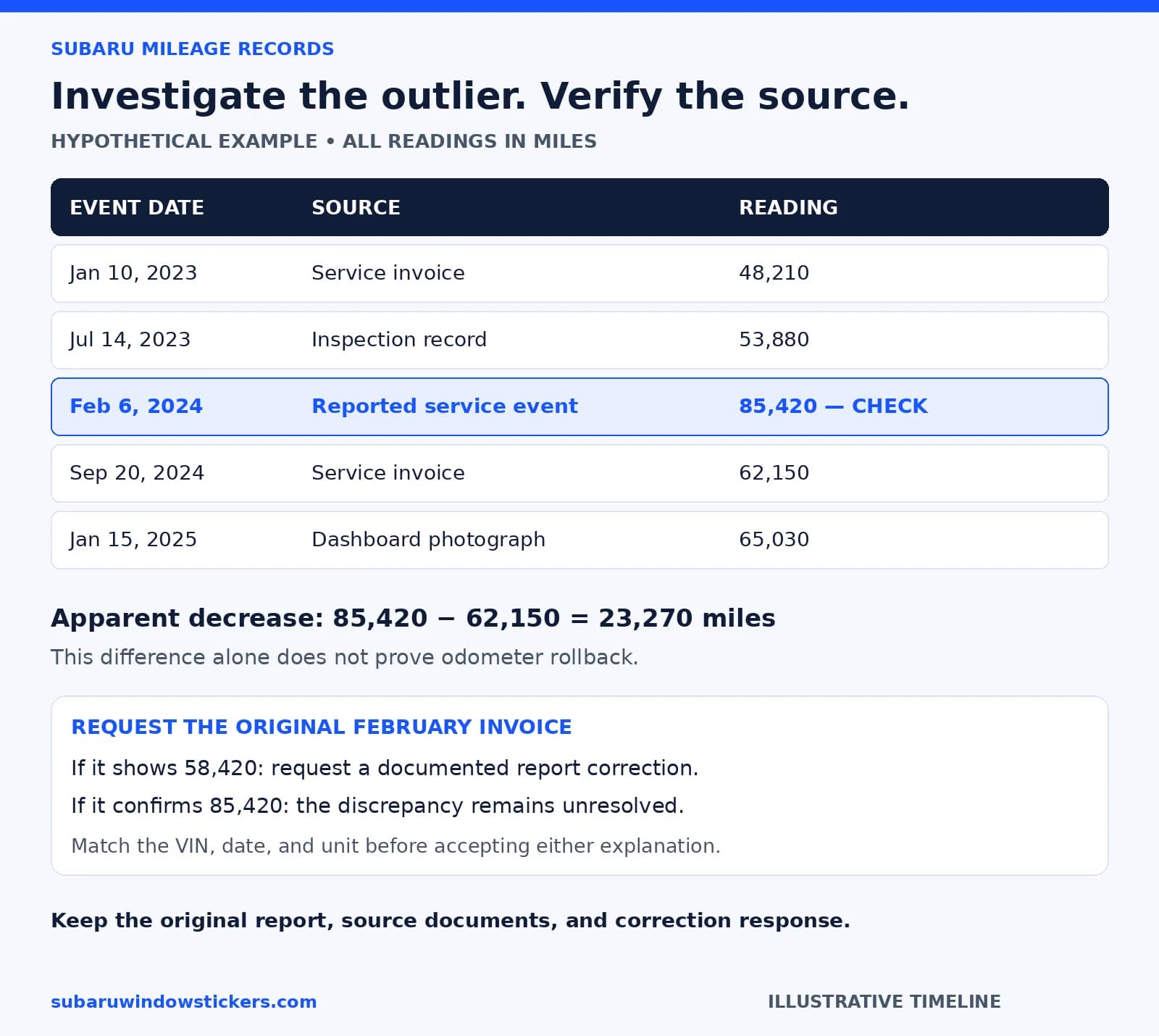
The following timeline is hypothetical. It demonstrates a method, not the history of a real Subaru or a result produced by this website. All entries are initially presented as miles, and the VIN is assumed to match across the documents.
Event Date | Source Shown | Recorded Mileage | Investigation Note |
January 10, 2023 | Service invoice | 48,210 | Obtain the invoice copy. |
July 14, 2023 | Inspection record | 53,880 | Confirm the inspection document. |
February 6, 2024 | Reported service event | 85,420 | Isolated higher value; source needed. |
September 20, 2024 | Service invoice | 62,150 | Compare with the earlier high reading. |
January 15, 2025 | Dashboard photograph | 65,030 | Confirm the photo belongs to this vehicle and date. |
The apparent decrease is 85,420 − 62,150 = 23,270 miles. That is the size of the inconsistency between two entries, not a proven rollback amount. You do not yet know whether the earlier number, later number, event date, or unit is incorrect.
Suppose the workshop supplies an original invoice showing 58,420 miles, with the same VIN and service date. That supports a transcription-error explanation for the reported 85,420 figure. The revised comparison becomes 62,150 − 58,420 = 3,730 miles, an increase between those two visits.
The next step is a documented correction request. Keep the original report, workshop invoice, provider response, and corrected report together. Do not describe the problem as resolved merely because your own spreadsheet now looks consistent.
If the workshop instead confirms 85,420 miles, the discrepancy remains. Request evidence around the later readings and any instrument-cluster work. A seller’s statement that it was “probably a typo” cannot outweigh a matching source document without additional explanation.
Check A Suspected Unit Mismatch With A Calculation
One mile equals 1.609344 kilometers. To compare a kilometer reading with a mileage record, divide kilometers by 1.609344. Keep rounding visible and retain the original figure in your worksheet.
For example, 100,000 kilometers ÷ 1.609344 ≈ 62,137 miles. A later entry of 62,200 miles would therefore represent an increase of roughly 63 miles, not a decrease of 37,800 miles. The apparent reversal disappears only if the original 100,000 figure was genuinely recorded in kilometers.
Do not use a convenient conversion as proof of the unit. Ask for the original document, a clear instrument display, or confirmation from the source that recorded the value. Where the units remain unknown, mark the comparison unresolved instead of selecting whichever interpretation supports the advertised mileage.
For broader context on report fields and summaries, check how to read a Subaru vehicle history report. It explains why detailed entries deserve review even when a summary does not flag a problem.
Request Evidence That Can Resolve The Discrepancy
The most useful document is one tied to the disputed event. Several records agreeing with each other can help establish a pattern, but they may repeat the same source. Look for independently dated observations rather than assuming that multiple matching report entries represent separate confirmations.
Pro tip: Name saved files with the event date, source, and recorded reading. Keep the original and corrected versions separately so you can explain what changed without losing the evidence that prompted the investigation.
Ask The Seller For Supporting Documents
Request service invoices, inspection records, mileage disclosures, and any instrument-cluster replacement paperwork around the conflicting dates. Ask the seller to explain the specific discrepancy in writing. Keep that explanation separate from verified documents. A confident response can help identify the next source to contact, but it does not resolve uncertainty.
Ask The Original Source To Verify Its Entry
Contact the workshop, inspection station, dealer, or titling agency associated with the disputed record through its official contact details. Provide the VIN, event date, and questioned value. Ask whether its original record supports the reported mileage and what correction process applies. Request written confirmation rather than relying on telephone reassurance.
How To Request A Mileage-Record Correction?
Start with the report provider when the displayed report is inconsistent, and involve the originating source when its record is wrong. An error in a repair invoice, an error in a state title record, and an error in a report’s presentation can require different correction routes.
Where The Problem Appears | First Contact | Evidence To Include |
Report differs from the original invoice | Report provider | Report entry and matching invoice |
Original service record contains an error | Workshop or dealership that created it | VIN, work order, date, and supporting readings |
State title mileage information appears wrong | Reporting state’s titling agency | Title documents and the evidence its process requires |
Different reports disagree | Each relevant provider | Conflicting entries and any source documents |
You can adapt this request:
Please review the mileage entry dated [date] for VIN [VIN]. The report shows [reading and unit], while the attached source document shows [reading and unit]. Please confirm the source and event date, investigate the discrepancy, and explain any correction made. If no correction is appropriate, please provide the reason and identify what additional evidence is needed.
Retain the case number and response. After a correction is confirmed, obtain the updated report and check that the specific entry changed as explained. A provider correction does not necessarily update a title, invoice, or every other database automatically.
When To Pause The Purchase Or Escalate?
You do not need to establish fraud to decide that the available evidence is insufficient for a purchase. Pause when the VIN cannot be reconciled, original documents support a higher mileage than the seller acknowledges, or important records remain contradictory after clarification attempts.
Ask an independent inspector to assess the Subaru’s condition and review relevant repair history. Pedal, seat, steering-wheel, or tire wear can prompt questions, but replacement parts and different usage patterns make wear an unreliable basis for assigning an exact lifetime mileage.
If you suspect deliberate tampering, preserve the listing, report, communications, and supporting records. Direct individual odometer-fraud concerns to the appropriate state enforcement agency. Describe what the evidence shows without presenting an unverified explanation as a fact.
Finish With An Explained Timeline
A useful mileage investigation ends with either a supported explanation and documented correction, or a clearly stated unresolved problem. Preserve the original evidence, compare like-for-like readings, and verify the record behind any reassuring explanation. A smoother-looking timeline is not enough by itself.
If you need recorded history to begin the comparison, use our Subaru VIN number lookup tool. A basic VIN decode cannot establish lifetime mileage; the useful evidence comes from dated records, current observations, and supporting documents tied to the vehicle.