
Search Vehicle Report
Table of Contents
Read a Subaru vehicle history report by matching the VIN first, reviewing title and damage records, and then following the dated mileage and ownership entries. Turn anything unclear into a request for documents or an inspection. A report describes information collected about a vehicle; it does not certify its current condition or guarantee that every event was reported.
The most useful result is a short list of questions you can resolve before buying. This guide explains the main sections, works through selected entries from a public Subaru sample, and shows how to separate a recorded fact from an assumption.
Key Takeaways
 Read the detailed timeline as well as the summary; investigate conflicting entries.
- Treat missing records as missing information, not proof that nothing happened.
- Combine the report with current ownership documents, repair evidence, and an independent inspection.
What A Vehicle History Report Can Tell You
A vehicle history report brings together records associated with a VIN. Depending on the provider and available data, those records can cover title events, mileage, damage, vehicle use, sales listings, and other history. Coverage varies: the presence of a section does not mean every relevant event has been captured.
A VIN decoder, a window sticker, and a history report answer different questions. A basic decode identifies encoded vehicle attributes, a window sticker describes original equipment and pricing, while a history report looks for recorded events over time. None replaces an examination of the vehicle you are considering.
Report area | Useful question | What the section does not establish alone |
Vehicle identity | Does this report match this Subaru? | Whether every decoded feature is still installed |
Title and brands | What title information or brand history is reported? | Current condition or permission to complete a transfer |
Accident and damage | What incident details are available? | Repair quality or the full extent of unreported damage |
Mileage | How do dated readings compare? | Exact current mileage or an explanation for every discrepancy |
Ownership and use | What changes or usage classifications appear? | How carefully each driver maintained the vehicle |
Service records | What completed work is documented? | Whether missing maintenance never happened |
Before Interpreting Any Result
Start with the report’s identity and timing. A detailed report for the wrong VIN is irrelevant, and an old report cannot establish what happened after it was generated. Keep the entire document available so you can read dates, source labels, notes, and definitions alongside the summary.
Match The Report To The Actual Subaru
Compare the complete VIN on the report with the dashboard, vehicle identification label, and sale documents. Confirm the model year and vehicle description as well. If these details disagree, resolve the identity issue first. Reading additional history cannot make an incorrect VIN report reliable for the Subaru you are inspecting.
Check The Report Date And Record Dates
Find when the report was generated, then check the date of each important event. Those dates answer different questions. A recently generated report can contain older records, while a saved report cannot show later updates. Ask for current information before relying on historical title, mileage, lien, or recall status alone.
Read These Six Sections In Order
Read high-consequence records before getting distracted by equipment lists or price estimates. The order below helps you identify identity, ownership, damage, and mileage questions early, then use the remaining sections to plan follow-up. Section names differ between providers, so look for the underlying information rather than identical headings.
1. Title Status And Brand History
Look for title dates, issuing states, and any recorded brands. Keep salvage, rebuilt, flood, and other labels separate from ordinary registration events. A report showing no brand does not prove the Subaru has never been damaged. If a brand appears, investigate its meaning with the relevant state authority before proceeding.
2. Accident And Damage Entries
Read the incident date, reported location, damage description, and source when available. Do not translate a short severity label into a repair estimate or safety verdict. Ask for photographs, repair invoices, and inspection findings. Multiple entries may describe one incident, so compare their dates and details before counting separate crashes.
3. Odometer Readings And Mileage Notes
Arrange reported mileage readings by date and check their units. Look for decreases, unexplained jumps, and readings that disagree with the dashboard. A discrepancy needs investigation; it is not automatic proof of rollback. Compare the original records before deciding whether timing, entry errors, unit differences, or tampering explain the inconsistency.
4. Ownership Changes And Vehicle Use
Review ownership periods alongside registration, title, lease, fleet, and sale entries. Do not count every registration renewal as a new owner. Usage labels describe reported classifications rather than driving quality. Ask how the Subaru was used and request supporting maintenance records instead of assuming that fewer owners means better care.
5. Service Records And Maintenance Information
Separate completed service entries from suggested maintenance schedules and estimated repair costs. A schedule describes recommended work; it does not prove that work occurred. Look for dates, mileage, workshop details, and invoice descriptions. If records are sparse, request receipts from the seller and let an inspection guide further maintenance questions.
6. Liens, Theft, And Recall Information
Read any lien, theft, or recall entry with its date and source. Historical records do not establish current status. Ask for current ownership and lien documentation, investigate unresolved theft information, and confirm recall applicability and completion separately. Do not treat an old report as clearance to pay for the Subaru.
Worked Example: Reading A Public Subaru Report
Here’s a Subaru Forester sample report that displays a generation date of September 26, 2025. These selected entries illustrate report reading, not a current appraisal or endorsement of that vehicle. The underlying source records were not independently obtained.
Date | Reported Entry | Reading Or Detail |
January 2, 2017 | Title with lien | 5 miles |
May 31, 2017 | Accident | Rear impact; minor damage reported |
September 23, 2023 | Dealer listing | 110,273 miles |
September 28, 2023 | Title event | 110,271 miles |
October 30, 2024 | Title event | 115,242 miles |
The two September readings decrease by 2 miles. That discrepancy deserves clarification, not a rollback accusation. The summary indicates no mileage discrepancy, despite the decrease. It also indicates no auction/sales records, while the detailed history includes such events. Ask the provider to explain those inconsistencies before relying on its summary.
Reading result: Request mileage source documents, accident repair evidence, and current lien information. The sample supports questions to investigate; it does not settle them.
Turn Report Findings Into Useful Follow-Up
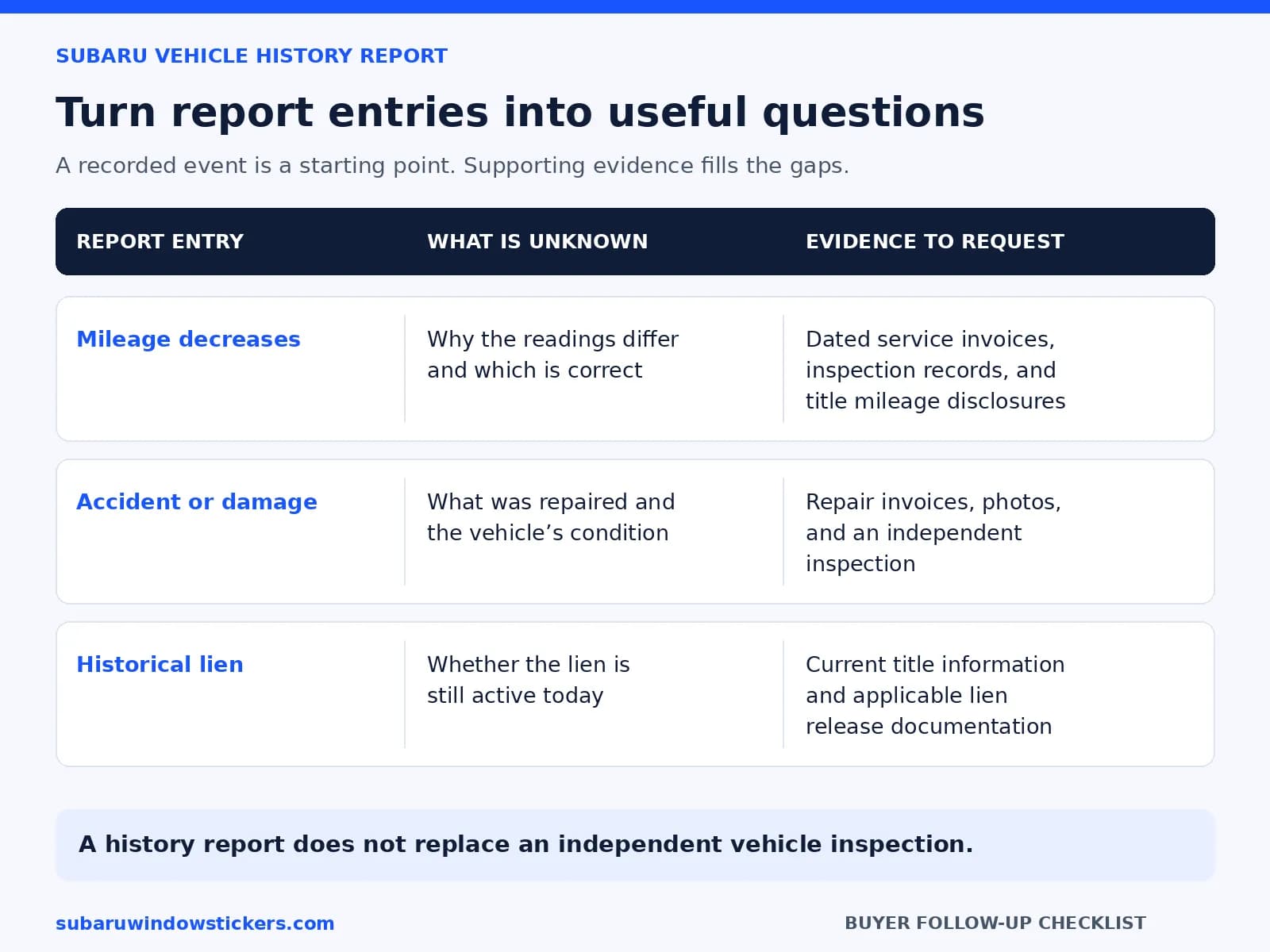
Write down each unresolved issue using three columns: the dated report entry, what remains unknown, and the evidence needed. This avoids mixing a database observation with a conclusion about the car. Keep the seller’s explanation alongside the supporting document so you can see whether the explanation actually resolves the question.
Investigate Mileage With Original Records
Ask for dated service invoices, inspection records, and title mileage disclosures around the questionable reading. Compare those documents with the current odometer and confirm whether values use miles or kilometers. Record the discrepancy without changing the report yourself. If evidence remains inconsistent, postpone the purchase while the provider investigates further.
Follow Damage Records Through To Repairs
Use the reported impact area to focus your questions, then ask an independent inspector to assess the vehicle broadly. Request invoices showing what was repaired or replaced and any relevant inspection documentation. A seller’s description of cosmetic damage is an explanation to verify, not a substitute for evidence of repairs.
Resolve Ownership And Lien Questions
Compare the seller’s authority to sell with the current title and any applicable lien documentation. A historical loan entry may remain visible after repayment, but its age does not prove release. Ask the relevant lender or titling authority what documentation is required for this transaction before committing your purchase funds.
Confirm Recall Status Near The Purchase
Treat a recall entry as a prompt to check current status for the exact VIN. Ask an authorized dealer whether the campaign applies and whether completion is documented. A campaign announcement and a completed repair are different events. If work remains outstanding, discuss the remedy and timing before taking delivery.
Keep Supporting Evidence With The Report
For a deeper mileage investigation, see Subaru mileage record discrepancies. NHTSA’s odometer-fraud guidance also recommends comparing the odometer with title and maintenance records. A condition check can add context, but wear alone cannot establish an exact mileage figure.
You can also review the Subaru recall section. Confirm any unresolved campaign and repair status with an authorized dealer rather than treating historical report wording as a live completion record.
Do Not Confuse Missing Information With A Clean History
A blank section and a positive finding mean different things. Read the provider’s coverage notes and definitions before interpreting “none reported,” “not available,” or similar wording. Ask which sources were checked and whether the result reflects a completed search, an unavailable field, or a gap in supplied data.
A vehicle history report should accompany an independent inspection. Reports and inspections provide different evidence: one organizes available records, while the other examines the vehicle you may buy.
No Accident Record Is Not An Inspection
An empty accident section means the report did not return an accident record within its available coverage. It does not demonstrate that every panel, safety system, or structural component is undamaged. Inspect the Subaru independently, especially when paint differences, unusual wear, seller statements, or repair paperwork raise questions worth investigating.
No Service Record Is Not Proof Of Neglect
Missing service entries can reflect work that never reached the report provider. Ask the seller for invoices before concluding that maintenance was skipped. Conversely, a long list of recorded visits does not establish that every required task was completed. Match documented work to the vehicle’s applicable maintenance requirements and conditions.
What To Ask The Seller After Reading The Report?
Send questions that refer to dates and documents, rather than asking for broad reassurance. You can adapt this message to the issues your report actually raises:
I have reviewed the vehicle history report for this Subaru. Please provide the current ownership documents, service invoices, and repair records relevant to the entries I have highlighted. For any mileage discrepancy, please share the original document showing the recorded reading. Please also confirm whether any reported lien remains active and provide applicable supporting documentation. I would like an independent inspection before deciding whether to proceed.
Only request evidence relevant to your findings. If there is no reported damage, for example, do not imply that a collision occurred. If the seller provides new paperwork, compare its VIN, dates, mileage, and descriptions with the report before considering the question closed.
For the broader document review, read about the documents to check before buying a used Subaru. It connects history findings with the ownership, inspection, and purchase paperwork you need to assess the transaction.
Decide What The Report Changes About Your Purchase
A history report should change your next action when it reveals a material issue. Avoid giving every entry equal weight: a routine renewal and an unresolved identity conflict do not deserve the same response. Use this table to organize your decision without treating it as a mechanical pass-or-fail score.
Finding | Practical Next Action |
VIN does not match the vehicle | Resolve identity before using the report or proceeding. |
Brand, total loss, or significant damage is reported | Obtain supporting records and assess repair, registration, and insurance implications. |
Mileage entries conflict | Request original readings and a provider review; avoid assuming the cause. |
Old lien information appears | Confirm current status and the required transaction documents. |
Maintenance history is incomplete | Seek invoices and discuss condition and maintenance needs with the inspector. |
No material issue appears in available records | Continue the inspection and ownership checks; this is not a condition guarantee. |
Keep a short unresolved-items list. If a concern affects identity, ownership, mileage reliability, or safety and the available evidence does not resolve it, delay the decision. A lower asking price does not explain a conflicting record or supply missing repair documentation.
Use The Report To Ask Better Questions
A Subaru vehicle history report is most useful when you read it as a set of dated records. Identify what is reported, distinguish that from what remains unknown, and obtain the evidence needed to close important gaps. The summary helps you navigate; the detailed entries deserve the final review.
Start by conducting a Subaru VIN number lookup and review the sample and available coverage before ordering. Keep your report, seller responses, inspection findings, and purchase documents together so your decision rests on evidence you can trace.