
Subaru Window Sticker vs. Dealer Addendum: Comparison Guide
Search Window Sticker
Table of Contents
A Subaru window sticker shows the vehicle’s original manufacturer pricing and listed equipment, while a dealer addendum is a dealership document that lists accessories, products, services, or an additional markup. Compare the two documents line by line, and check the agreed figures against an itemized purchase quote. However, neither sticker alone tells you the complete amount you will pay.
The useful question is not simply, “Why are the totals different?” It is, “What cost does each difference add, and have I already been charged for it?” This guide explains how to answer that question before signing the paperwork.
Key Takeaways
 Use the manufacturer’s total MSRP as a reference, keeping it separate from the dealer’s asking price.
- Match equipment descriptions, package contents, and part numbers before treating similar charges as duplicates.
- Request a written out-the-door price, including taxes and fees, and reconcile it with the final paperwork.
What Does Each Document Tell?
The original manufacturer label, commonly called a window sticker or Monroney sticker, identifies the specific vehicle and itemizes manufacturer pricing. Federal labeling requirements include the suggested vehicle price, separately priced optional equipment, transportation charges, and their total. The dealer addendum provides a separate view of dealership additions or pricing adjustments.
Start by checking the document’s source and headings. A dealer logo, a Subaru name, or placement beside the factory label does not make the two documents interchangeable. Use the table below to decide which record answers your question.
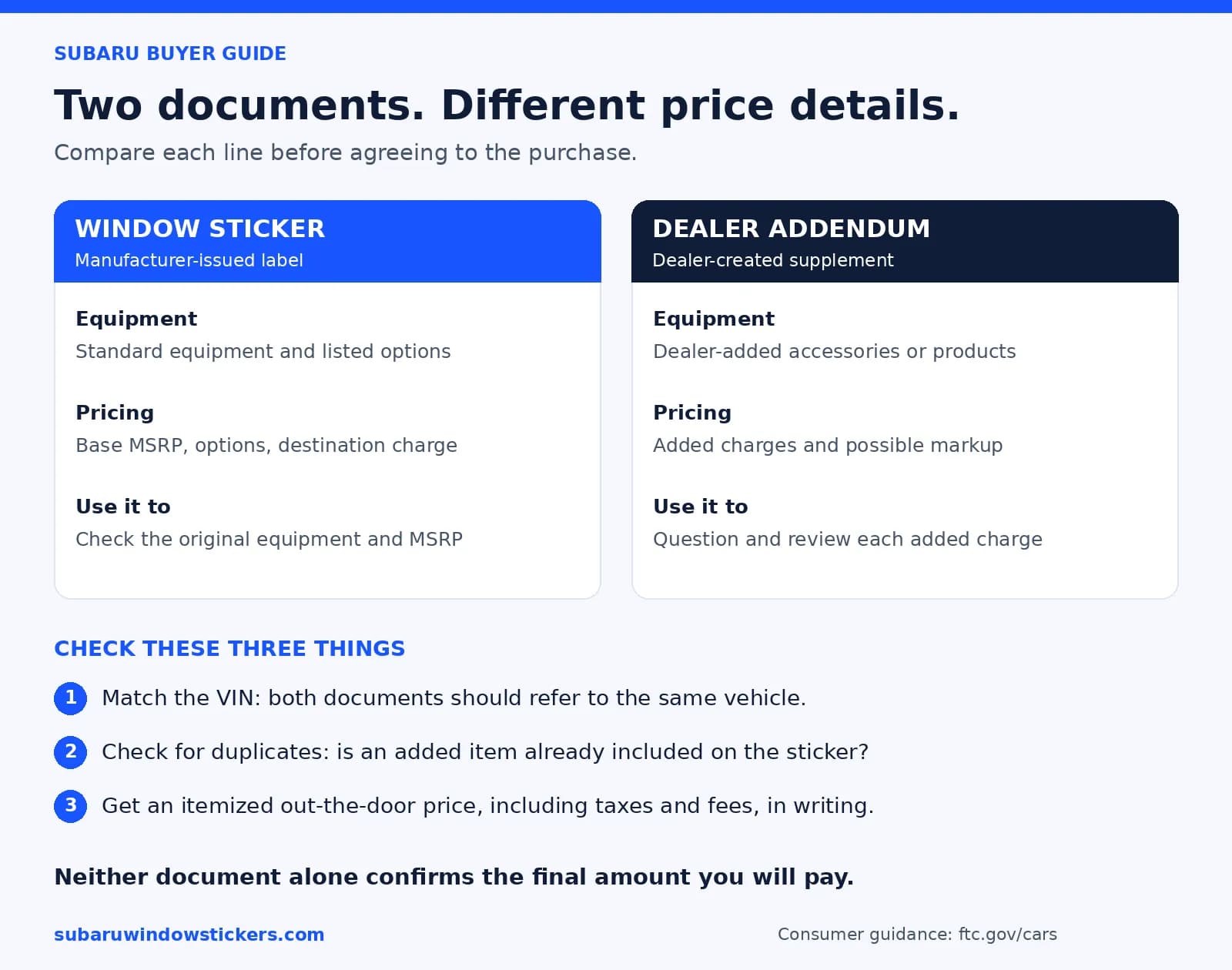
What To Compare | Subaru Window Sticker | Dealer Addendum |
Document source | Manufacturer label for the vehicle | Dealership-created supplement |
Equipment information | Standard equipment and listed options or packages | Dealer-added accessories, products, or services |
Price information | Base MSRP, separately priced options, destination, and total | Additional charges, possible markup, and sometimes an asking-price total |
Best use | Establish the original equipment and price baseline | Understand what the dealership is adding or charging |
Important limitation | Does not establish today’s condition or final selling price | Does not independently prove installation, product value, or coverage |
Compare The Documents In Four Steps
Put the window sticker, dealer addendum, online advertisement, and written quote beside each other. Save complete copies rather than cropped totals. Your first pass should establish vehicle identity, the manufacturer’s baseline, the meaning of additional charges, and the amount the dealer actually proposes to collect.
1. Match the VIN and Vehicle Details
Compare the VIN on the Subaru window sticker, dealer addendum, and vehicle. Check the model year and trim alongside it. If the addendum omits a VIN, ask the dealer to identify the vehicle in writing. Similar colors or equipment do not establish that two documents describe the same individual car.
2. Find The Total Manufacturer Price
Locate the base MSRP, separately priced options, destination charge, and total on the Subaru window sticker. Start your comparison from that total, not the base price alone. Otherwise, equipment already included in the manufacturer’s total can appear to be an unexplained dealer increase when it is simply being counted incorrectly.
3. Classify Every Dealer-Added Line
Read each dealer addendum entry as a separate purchase decision. Identify whether it describes a physical accessory, a service, a protection product, or a markup. Ask for an itemized explanation of vague packages. A charge with no equipment attached should not be mistaken for an upgrade to the Subaru itself.
4. Reconcile The Written Purchase Quote
Compare the dealer’s written quote with both stickers. Trace each addition, discount, and fee to a named line. Ask for the out-the-door price before discussing monthly payments. Keep financing costs separate from this purchase comparison, because loan interest changes the overall cost without changing the vehicle’s original manufacturer sticker price.
Pro tip: Photograph both stickers in full, then take close-ups of the equipment and price sections. Save the listing on the same day so you can identify changes in descriptions, included accessories, or advertised pricing.
Which Addendum Charges Deserve A Closer Look?
An unfamiliar charge is a reason to ask questions, not proof of wrongdoing. Your goal is to establish what is included, what has actually been supplied, and whether you want it at the quoted price. Four categories deserve different checks because they represent different kinds of value.
Accessories And Bundled Equipment
Compare accessory descriptions across the Subaru window sticker and dealer addendum. A cargo tray listed individually might also appear inside a broader package. Ask for package contents and part numbers before calling it a duplicate. Similar names can describe different products, while different names can sometimes describe the same item.
Destination And Additional Delivery Charges
Find the destination charge already included in the window sticker total. If the dealer addendum also lists delivery, freight, or transportation, ask what separate service that charge covers. A requested home delivery is different from repeating the manufacturer’s destination charge. Resolve the description before accepting the additional amount as justified.
Protection Products And Service Contracts
For a coating, protection plan, or service contract, request the actual written terms. Check the provider, covered events, exclusions, duration, and any deductible. A product name on the dealer addendum does not explain its benefits. Compare proposed coverage with existing coverage before deciding whether the additional purchase serves your needs.
Market Adjustments And Dealer Markups
A market adjustment increases the dealer’s asking price without necessarily adding equipment. Keep that amount separate from accessories when comparing offers. Ask whether the dealer will reduce the adjustment or offer another vehicle without it. Judge the complete written offer, rather than assuming a higher total represents more Subaru features.
Verify Equipment And Coverage With Supporting Records
For equipment questions, use the Subaru options on the window sticker as a starting point for checking available configuration information. Then compare the relevant records with the actual vehicle. A listing description or lookup result cannot establish that an accessory remains fitted and functional today. A genuine branded accessory does not, by itself, establish where or when it was installed.
Worked Example: Follow The Price From Sticker To Quote
The following figures are hypothetical. They demonstrate the comparison method and are not current Subaru prices, a real dealer offer, or a sample report from this site. Taxes and registration are deliberately excluded because the applicable amounts depend on the transaction and location.
Manufacturer Window Sticker Line | Illustrative Amount |
Base MSRP | $30,000 |
Optional equipment package | $1,500 |
Destination charge | $1,300 |
Total manufacturer MSRP | $32,800 |
The dealer then presents this addendum:
Dealer Addendum Line | Illustrative Amount | Question To Resolve |
Cargo accessory bundle | $450 | Are any of its items already in the sticker package? |
Protection product | $800 | What product and written coverage are being supplied? |
Market adjustment | $1,200 | Is the dealer willing to revise this markup? |
Total additions | $2,450 | Confirm how each line enters the quote. |
How to Use the Information ?
The initial asking price is $32,800 + $2,450 = $35,250, before taxes and other applicable fees. The $2,450 difference is not all equipment: $1,200 is a markup, and the protection product needs its own evaluation.
Suppose the dealer agrees to remove the $800 product charge and reduce the markup by $600. The revised subtotal is $35,250 − $800 − $600 = $33,850. This remains a subtotal, not an out-the-door price. Ask for the complete revised quote with each applicable tax and fee identified.
Now check the accessory bundle. If the $1,500 manufacturer package already includes one of its items, ask whether the dealer is supplying a different item or charging again for the same one. Do not deduct the entire $450 automatically: the bundle might contain several components with different values.
Finally, verify that the revised quote starts from the $32,800 total only once. Adding the $1,500 package or $1,300 destination charge again would repeat an amount already included in that baseline. Keep your calculation attached to the quote so the comparison remains easy to follow.
What To Do When The Paperwork Disagrees
A mismatch should end with a clear explanation or a corrected document. Avoid relying on a verbal assurance that the finance office will “sort it out.” Identify the specific line, ask who will correct it, and review the updated version before treating the issue as resolved.
Request Evidence For Unclear Items
Ask the dealer to connect each disputed accessory charge to a specific item, part number, or installation record. For a service or protection product, request its written description and terms. Record the response beside the charge so an explanation given during the vehicle inspection is available when reviewing the contract.
Get Changes Into The Final Paperwork
If the dealer agrees to remove a charge, change a price, or install an accessory later, have the agreement reflected in the purchase paperwork. For promised installation, identify the item and completion date. Recheck the revised total yourself. A corrected addendum alone does not confirm the final contract was updated.
Ask For The Paperwork Before Your Appointment
You can send this request before your appointment:
Please send the window sticker, dealer addendum, and an itemized out-the-door quote for the vehicle identified by this VIN. Please separate the vehicle selling price, accessories, protection products, dealer fees, taxes, and registration charges. Identify any discount conditions and explain whether the quoted accessory prices include installation. If an item appears on both stickers, please confirm whether it is already included in the manufacturer’s total or is a separate addition.
Keep the reply with the listing and quote. If the dealer substitutes another vehicle or changes the package during negotiations, restart the comparison using the new documents. An explanation for one Subaru should not be carried over to another automatically.
How The Comparison Changes For A Used Subaru
For a used Subaru, an old window sticker and addendum describe an earlier transaction. They can help explain original equipment and historical pricing, but they cannot establish the vehicle’s current condition or everything included in today’s sale. Separate those historical records from the current seller’s offer.
Separate Historical Charges From Today’s Value
An original dealer addendum can explain what a previous buyer was offered, but its prices do not establish current value. Accessories may have worn out, been removed, or been replaced. Inspect what remains and assess its usefulness today instead of adding historical accessory charges directly to the used Subaru’s price.
Check Current Equipment And Coverage Separately
Compare the used Subaru’s physical equipment with the historical paperwork, then request current sale and coverage documents. An old protection plan may have expired or require a transfer. Confirm eligibility with the provider. Use an independent inspection to assess condition; matching stickers cannot establish mechanical health or verify repair quality.
A Final Check Before You Sign
Keep this short checklist beside the written quote:
- Same vehicle: The VIN and vehicle description match the Subaru you inspected.
- Clear baseline: You can identify the manufacturer’s total without adding its components twice.
- Explained additions: Each accessory, product, service, and markup has a clear description and price.
- Resolved overlap: Similar equipment entries have been checked against package contents.
- Recorded agreement: Removed charges and promised work appear in the updated paperwork.
- Complete total: Taxes, fees, and discount conditions are visible in the written purchase quote.
If a line remains unclear, ask for the explanation before signing. The comparison is useful only when you understand how the individual amounts produce the total you are accepting.
Compare The Documents, Then Confirm The Deal
Use the Subaru window sticker to establish the original equipment and manufacturer pricing baseline. Use the dealer addendum to examine dealership additions separately. Finish by matching both documents to the vehicle and the written purchase agreement.
The best outcome is a clear, traceable offer: you know what is included, which additions you want, and how the final purchase price was calculated. Save the complete set of documents together so the same record supports your decision, any promised installation, and later questions about the transaction.